Finance
Global banking stocks delivered a mixed performance as strength among several European financial institutions contrasted with weakness in key U.S. banking benchmarks. While select banks continued to attract investor interest, sector-wide indices indicated a more cautious tone across parts of the financial industry.
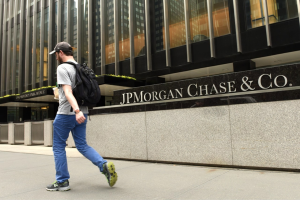
U.S. banking performance was uneven during the session. JPMorgan Chase (JPM) declined 0.41% to close at $319.40, while Bank of America (BAC) slipped 0.27% to $55.87. The broader U.S. banking sector also weakened, with the KBW Nasdaq Bank Index (^BKX) falling 0.63% to 178.66 and the Invesco KBW Bank ETF (KBWB) declining 0.57% to $92.07. The decline in both sector benchmarks suggests that selling pressure extended beyond individual institutions and affected a wider range of banking shares.
European banks, however, showed stronger momentum. HSBC Holdings (HSBC) advanced 0.27% to $92.92, while UBS Group (UBS) gained 1.18% to $49.55. The strongest performance came from BNP Paribas (BNP.PA), which rose 2.03% to €98.65. Supporting the positive regional trend, the Euro Stoxx Banks Index (SX7E.Z) climbed 2.07% to 283.70, significantly outperforming U.S. banking benchmarks and highlighting stronger investor demand for European financial institutions.
Banking-sector performance continues to be heavily influenced by expectations surrounding monetary policy, inflation trends, and economic growth prospects. Financial stocks remain particularly sensitive to signals from the Federal Reserve, the European Central Bank, and the Bank of England because interest-rate expectations directly affect net interest income, lending activity, and profitability.
The divergence between U.S. and European banking performance suggests that investors may be assessing regional economic conditions differently. European banks benefited from stronger institutional demand, reflected in the sharp rise of the Euro Stoxx Banks Index and gains among BNP Paribas, HSBC, and UBS. Meanwhile, weakness in the KBW Nasdaq Bank Index and KBWB indicates a more cautious stance toward the broader U.S. banking sector despite relatively modest declines in major U.S. bank shares.
No specific earnings announcements, merger activity, or regulatory developments were included in the provided data. As a result, broader macroeconomic considerations remain the primary factors influencing investor positioning.
Investor sentiment appeared selective rather than broadly risk-on. The decline in U.S. banking benchmarks alongside gains in several major European banks indicates that investors were differentiating between regional opportunities rather than uniformly increasing or reducing exposure to financial stocks.
Market participants continue to monitor credit quality, loan demand, deposit flows, and commercial lending activity for signals regarding future earnings performance. The stronger performance of European financial institutions suggests investors currently view certain international banking markets as offering more favorable near-term conditions.
From a broader perspective, banking stocks remain an important indicator of confidence in economic activity. Diverging performance across regions may reflect differing expectations regarding growth, monetary policy, and financial-sector profitability over the coming quarters.
Attention will remain focused on whether the weakness in U.S. banking benchmarks develops into a broader trend or proves to be a temporary pullback following recent gains. The performance of the KBW Nasdaq Bank Index and KBWB will be important indicators of sector-wide sentiment in upcoming sessions.
BNP Paribas stands out as a key stock to watch after posting the strongest gain among the major institutions tracked. If European banking indices continue to outperform, international financial stocks could attract additional investor attention. Conversely, if U.S. banking benchmarks stabilize and recover, market leadership could shift back toward large American banks such as JPMorgan Chase and Bank of America.
The latest session highlighted a notable contrast between U.S. and European banking performance. While JPMorgan Chase and Bank of America posted modest declines and U.S. banking benchmarks moved lower, HSBC, UBS, BNP Paribas, and the Euro Stoxx Banks Index recorded gains. This divergence underscores the importance of regional economic expectations in shaping financial-sector performance. Investors will continue monitoring central bank policy signals, lending conditions, and broader economic indicators to assess whether current leadership trends within the global banking industry persist.
Confidential: This material is for internal editorial use only and reflects structured market analysis based on available data.
 Previous Post
 SKN | HSBC’s Singapore Insurance Business Attracts Allianz as Leading Bidder, Signaling Strategic Consolidation in Asian Wealth Markets
Next Post SKN | Charles Schwab Accelerates Asset Growth as Client Activity Surges

October 8, 2026

October 8, 2026

October 8, 2026

October 8, 2026
 Optimized by Seraphinite Accelerator