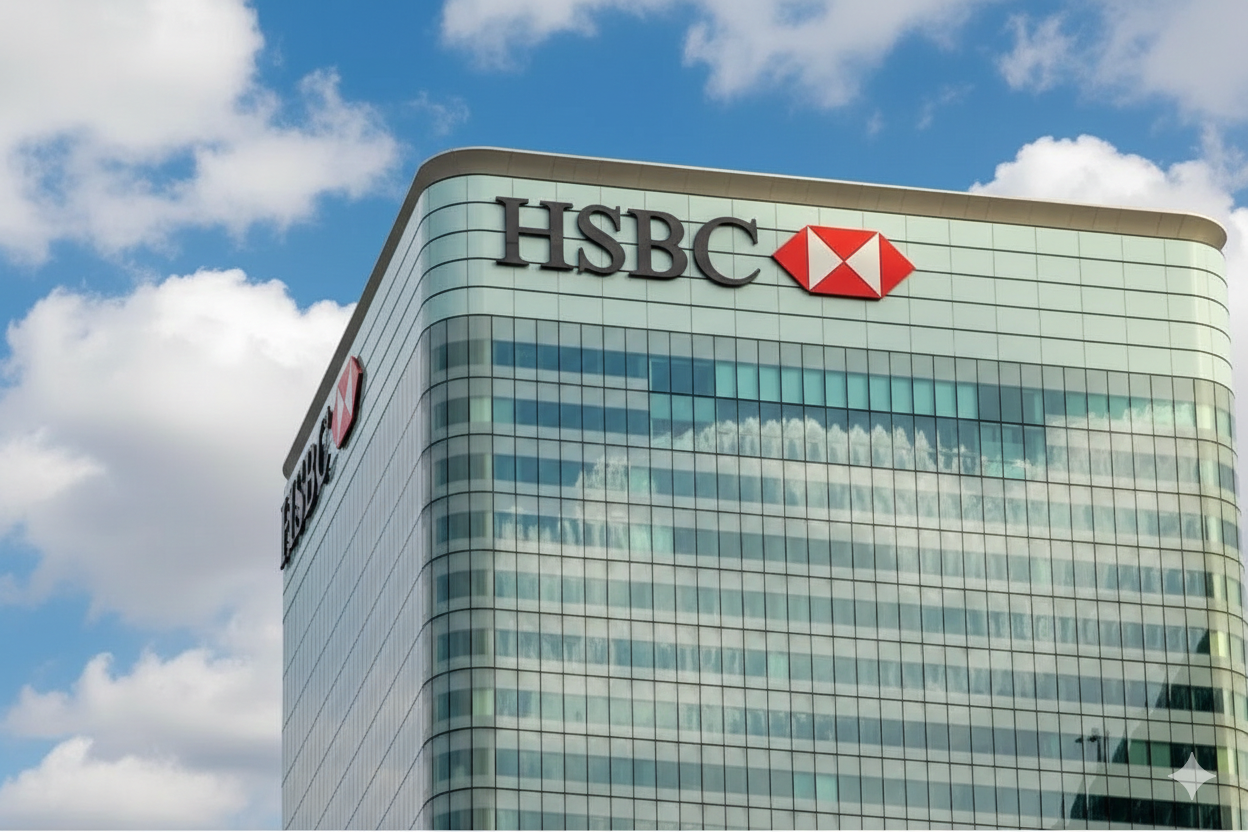
Stock market
HSBC’s share price has surged more than 60% over the past year, raising the bar for further upside and increasing sensitivity to earnings and guidance.
Valuation signals are mixed: excess returns analysis implies upside, while P/E multiples suggest the market is already paying a premium versus peers.
The investment case now hinges less on recovery and more on whether HSBC can sustain elevated returns on equity through the next phase of the cycle.
HSBC Holdings has delivered one of the strongest rallies among large global banks, with the shares up roughly 60% over the past 12 months and more than 300% over five years. Short-term momentum has remained positive, but the scale of the move naturally raises a tougher question for investors: how much good news is already reflected in the price?
HSBC’s recent performance reflects a broad re-rating of global banks as rate expectations, capital returns, and cost discipline improved sentiment across the sector. As one of the world’s largest and most diversified lenders, HSBC has benefited from renewed confidence in balance-sheet strength and earnings resilience, particularly compared with the post-crisis years when returns lagged peers.
That shift in perception helps explain why the stock now trades well above levels seen even a year ago.
Using an excess returns framework, HSBC appears attractively valued. This approach looks at whether the bank is expected to generate returns on equity above its cost of equity and capitalizes that excess into an intrinsic value.
On these assumptions, HSBC’s implied intrinsic value sits meaningfully above the current share price, suggesting the stock could still be undervalued on a long-term fundamentals basis. For investors who believe HSBC can sustain mid-teens returns on equity, this model supports the argument that the rally has not fully exhausted upside.
The picture becomes less clear when viewed through traditional multiples. HSBC currently trades on a P/E ratio materially above both the banking sector average and many large-bank peers. That premium implies the market is already pricing in higher-quality earnings, lower risk, or superior growth prospects.
Compared with modelled “fair” P/E ratios that adjust for growth, margins, and risk, HSBC looks fully valued to stretched on this measure. In practical terms, that means further gains may require either stronger-than-expected earnings delivery or continued multiple expansion—both harder to achieve after a sharp run.
Taken together, the valuation signals suggest HSBC is no longer a recovery or deep-value story. Instead, the shares now reflect expectations of sustained profitability, disciplined capital returns, and stable global operations. That does not rule out further upside, but it does mean disappointment carries more downside risk than it did a year ago.
For existing shareholders, the debate is less about whether HSBC is “cheap” and more about whether the quality and durability of earnings justify the premium now embedded in the stock.
HSBC’s strong rally has reset expectations. Long-term valuation models still leave room for upside if returns on equity remain robust, but relative valuation shows the market is already paying up for that outcome. From here, performance is likely to be driven by execution rather than sentiment alone.
For a confidential discussion on how large-bank valuation, capital-return durability, and global rate exposure can be assessed within a diversified portfolio allocation, contact our senior advisory team.
 Previous Post
 SKN | Morgan Stanley Reassesses Five9 as AI Risk Narrative Softens for SaaS
 Next Post
 SKN | Truist Trims Capital One Target as Brex Deal Shifts Focus to Costs and Execution

March 27, 2026

March 27, 2026

March 27, 2026

March 26, 2026
 Optimized by Seraphinite Accelerator