Stock market
• Wall Street sentiment on Charles Schwab has shifted more constructive, with a clear tilt toward upside despite a mixed Q4 revenue print.
• Analysts are increasingly focused on earnings acceleration in 2026 rather than near-term topline noise.
• Price targets imply meaningful upside, but the stock is entering a zone where execution and rate dynamics matter more than multiple expansion.
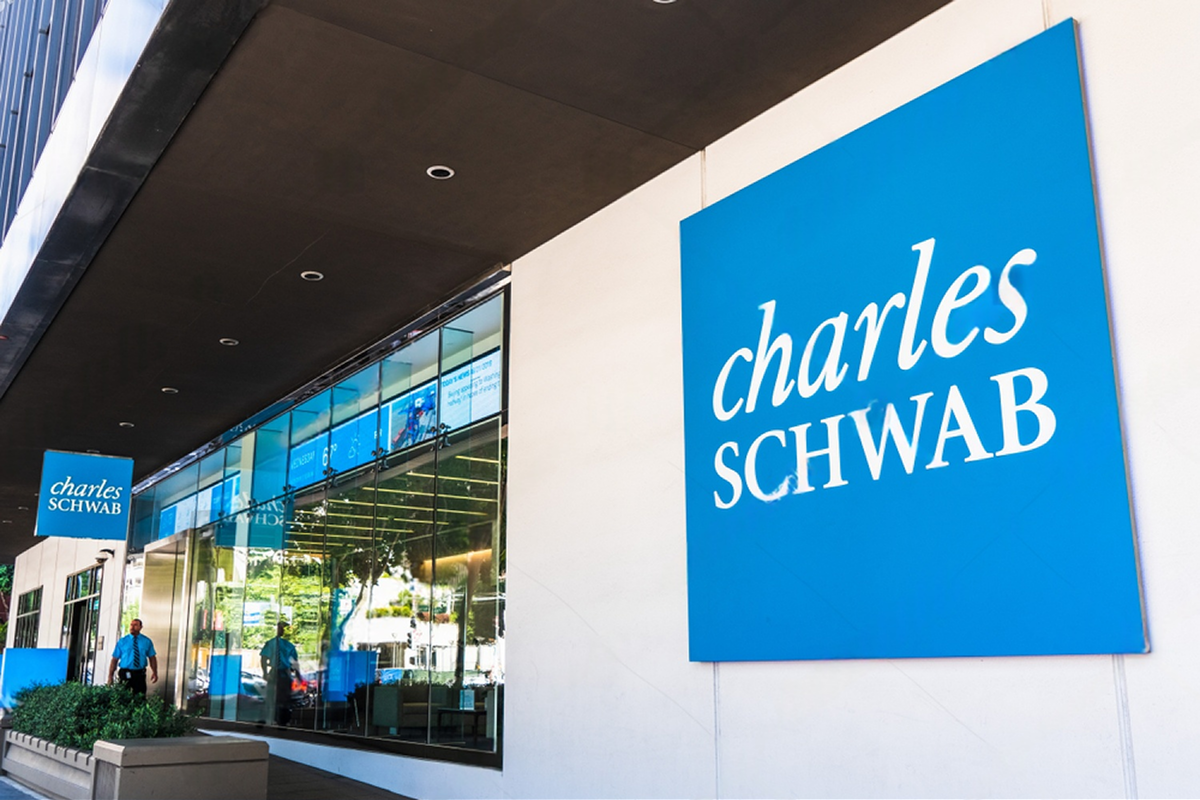
The Charles Schwab Corporation continues to attract positive attention from Wall Street analysts as its shares outperform both the broader market and sector peers. Over the past year, Schwab stock is up 24.3%, comfortably ahead of the S&P 500’s ~14.3% gain, and it has extended that relative strength into 2026 with a 4% year-to-date rise.
Among the 22 analysts covering Schwab, the consensus rating stands at “Moderate Buy.” The distribution is skewed positive, with 13 Strong Buys, a handful of Buys and Holds, and only one Moderate Sell. Notably, sentiment has improved versus a month ago, when a more bearish outlier was still in the mix.
Price targets reinforce that constructive stance. The average target of $121.26 implies roughly 17% upside, while the more optimistic end of the range stretches as high as $148, pointing to over 40% potential upside. TD Cowen’s William Katz reiterated a Buy rating on January 30 with a $138 target, signaling confidence in Schwab’s earnings trajectory rather than near-term market conditions.
Schwab’s fourth-quarter results were mixed on the surface. Revenue of $6.3 billion came in slightly below expectations, while adjusted EPS of $1.39 met consensus. The muted reaction in the share price suggests investors are increasingly focused on the forward earnings path rather than quarter-to-quarter fluctuations.
That focus is supported by forecasts calling for 18.9% EPS growth in the current fiscal year, taking earnings to $5.79 per share. Schwab’s track record also helps: the company has beaten consensus EPS estimates in each of the past four quarters, reinforcing confidence in management’s execution.
The key debate is no longer whether Schwab can recover from the rate shock of the past cycle, but how much earnings leverage it can extract as conditions normalize. Net interest revenue sensitivity, client cash sorting behavior, and cost discipline will determine whether the stock merely grows into current expectations or exceeds them.
At current levels, Schwab is not priced for distress—but neither is it priced for perfection. That balance explains why analysts see upside, yet stop short of a unanimous “Strong Buy.”
Wall Street is clearly not predicting a collapse in Charles Schwab shares. Instead, analysts are broadly aligned around a view that earnings momentum in 2026 can drive further gains, provided execution remains tight and macro conditions do not deteriorate sharply. The stock’s next leg will be shaped less by sentiment shifts and more by delivery against those earnings expectations.
For a confidential discussion on how U.S. brokerage earnings sensitivity, interest-rate exposure, and capital durability at firms like Charles Schwab can be assessed within a global portfolio allocation, contact our senior advisory team.
 Previous Post
 SKN | BNP Paribas: Strategic Insights for HNWI Cross-Border Wealth Management
 Next Post
 SKN | MUFG Expands Long-Term Savings Push With Zero-Fee “Slim Course” iDeCo Pension Plan
March 27, 2026

March 27, 2026

March 27, 2026

March 26, 2026
 Optimized by Seraphinite Accelerator