

Finance
Major U.S. banking stocks declined during the November 5 trading session, with losses across leading financial institutions weighing on broader sector benchmarks. JPMorgan Chase (JPM), Bank of America (BAC), HSBC, and UBS recorded declines, while European banking performance remained comparatively resilient. The KBW Nasdaq Bank Index (^BKX) and Invesco KBW Bank ETF (KBWB) both fell more than 3.5%, highlighting the concentration of selling pressure in U.S. banking equities. By comparison, BNP Paribas and the European ESTX Banks I Index (SX7E) finished modestly higher, indicating a divergence between the two regional banking markets.
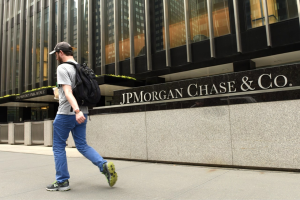
JPMorgan Chase declined 4.19% to $337.34, losing $14.77 during the regular session. Its after-hours price recovered 0.30% to $338.36, suggesting a modest stabilization following the substantial decline. Bank of America fell 3.62% to $49.76, while its after-hours price advanced 0.15% to $49.83. The bank also announced a cash dividend of $0.32, with an ex-dividend date of December 4, 2026.
HSBC declined 1.47% to $88.06, with after-hours trading showing a marginal decrease to $88.05. UBS recorded a larger decline, falling 3.75% to $48.77, with no change reported in after-hours trading.
European banking performance was more stable. BNP Paribas advanced 0.26% to €91.94, while the ESTX Banks I Index gained 0.26% to 290.24. In contrast, the KBW Nasdaq Bank Index dropped 3.57% to 171.21, and the Invesco KBW Bank ETF declined 3.54% to $88.03. The divergence highlights the relative weakness of U.S. banking shares during the session.
The supplied market data do not identify a specific Federal Reserve, European Central Bank, or Bank of England announcement behind the declines. Accordingly, the session’s movements cannot be directly attributed to a particular interest-rate decision, inflation report, or regulatory development.
Nevertheless, monetary policy expectations remain important to banking-sector valuations. Changes in interest rates influence lending margins, deposit costs, funding conditions, and credit demand. For internationally active institutions, these factors also affect capital allocation and cross-border banking operations.
The difference between U.S. and European performance warrants particular attention. While U.S. banking benchmarks experienced substantial losses, European institutions maintained positive territory. The available figures establish this regional divergence but do not independently identify its underlying catalyst.
The decline in JPMorgan, Bank of America, and UBS, alongside weakness in the KBW Nasdaq Bank Index and KBWB, indicates broader selling pressure across U.S. banking equities. HSBC’s smaller decline and BNP Paribas’s advance demonstrate that international banking performance was not uniform.
The modest after-hours recovery in JPMorgan and Bank of America may indicate some stabilization, although these movements remain insufficient to establish a sustained reversal. For institutional investors, the divergence reinforces the importance of evaluating individual balance sheets, funding structures, credit exposures, and capital adequacy rather than relying exclusively on broad sector movements.
Attention should remain on whether U.S. banking benchmarks stabilize following the latest declines and whether European institutions maintain their relative resilience. Upcoming earnings disclosures, central bank communications, credit conditions, and deposit trends will remain important indicators for assessing sector fundamentals. Bank of America’s dividend announcement also provides a relevant consideration for evaluating shareholder distributions. The sustainability of any recovery will ultimately depend on institutional profitability, capital strength, and funding resilience.
Confidential: This material is for internal editorial use only and reflects structured market analysis based on available data.
November 5, 2026
November 5, 2026
November 5, 2026

November 5, 2026
SKN | Bank of America Challenges Wall Street’s AI Spending Fears With a Longer-Term Chip Market Outlook
SKN | Wells Fargo Targets Top-Five Investment Banking Status as Deal Pipeline Reaches Record Levels
SKN | JPMorgan Warns Rapid Interest-Rate Increases Could Expose Financial System Liquidity Risks
 Optimized by Seraphinite Accelerator



