Finance
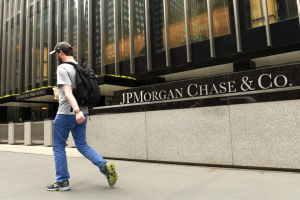
Global banking stocks moved lower as investors reduced exposure across both U.S. and European financial institutions. Weakness in major banking benchmarks was reflected in declines among leading banks including JPMorgan Chase (JPM), Bank of America (BAC), HSBC Holdings (HSBC), BNP Paribas (BNP.PA), and UBS Group (UBS), indicating a broadly cautious market environment.
U.S. banking stocks finished the session lower, tracking declines across key sector benchmarks. JPMorgan Chase closed at $300.85, down 0.04%, while Bank of America ended at $52.40, declining 0.15%. Broader sector performance was also negative, with the KBW Nasdaq Bank Index (^BKX) falling 1.44% to 169.19. The Invesco KBW Bank ETF (KBWB) declined 1.39% to $87.16, reflecting broad-based weakness across U.S. financial stocks.
European banks also faced selling pressure. HSBC Holdings dropped 1.65% to $93.64, while BNP Paribas declined 1.30% to €93.20. UBS Group fell 1.74% to $47.32, marking one of the steeper declines among major banks tracked in the session. The broader European sector weakened as the Euro Stoxx Banks Index (SX7E.Z) fell 1.66% to 268.32. The simultaneous declines in both U.S. and European benchmarks suggest that investor caution extended across regions rather than being driven by a single market-specific factor.
The market data points to a session dominated by risk reduction rather than stock-specific developments. Banking shares remain highly sensitive to expectations surrounding monetary policy, interest-rate trajectories, and economic growth prospects. Investors continue to monitor signals from major central banks, including the Federal Reserve, the European Central Bank, and the Bank of England, as these institutions influence lending profitability, funding costs, and credit demand.
Higher-for-longer interest-rate expectations can support net interest income, but they may also create concerns about slower borrowing activity and increased credit stress. As a result, banking stocks often react to shifts in expectations regarding inflation and economic growth. The declines across both U.S. and European banking indices suggest that investors may have focused on macroeconomic uncertainty rather than company-specific earnings or regulatory announcements during the session.
Investor sentiment appeared cautious, with banking shares underperforming as sector indices moved lower. The declines in both ^BKX and KBWB indicate broad-based weakness across U.S. financial institutions, while the fall in SX7E.Z highlights similar concerns among European lenders. Such moves typically reflect a more defensive market posture, particularly when investors reassess growth expectations and the outlook for credit conditions.
Bank profitability remains closely tied to lending activity, deposit trends, and overall economic momentum. When sector-wide indices decline alongside major banks, investors often focus on the sustainability of loan growth and the potential impact of changing monetary conditions. The synchronized weakness across regions suggests that market participants are evaluating broader macroeconomic risks rather than isolated company developments.
The next trading session will likely focus on whether banking indices can stabilize after the broad pullback. The KBW Nasdaq Bank Index (^BKX) and the Euro Stoxx Banks Index (SX7E.Z) will remain important indicators of sector direction. If these benchmarks recover, investors may interpret the recent decline as a short-term consolidation. If weakness persists, attention could shift toward additional pressure on major banking stocks.
Among individual names, JPMorgan Chase remains a key stock to monitor due to its influence on overall sector sentiment. Future moves may depend on incoming economic data, inflation indicators, and central bank communications. Changes in currency markets could also influence multinational institutions such as HSBC, BNP Paribas, and UBS through their international revenue exposure.
The banking sector experienced a broadly negative session, with weakness extending across major institutions and benchmark indices in both the United States and Europe. JPMorgan Chase, Bank of America, HSBC, BNP Paribas, and UBS all finished lower, while sector-wide measures including ^BKX, SX7E.Z, and KBWB also declined. Investors will continue monitoring economic indicators, interest-rate expectations, and credit conditions for clues regarding future sector performance. The direction of banking indices remains one of the most important signals for assessing near-term momentum across global financial stocks.
Confidential: This material is for internal editorial use only and reflects structured market analysis based on available data.
 Previous Post
 SKN CBBA | Julius Bär Valuation Raises Questions After Strong Share Price Performance
Next Post SKN | Regulatory Recalibration in the United States: What the Removal of “Reputation Risk” Means for Wealth Preservation Strategies

September 9, 2026

September 9, 2026

September 9, 2026

September 9, 2026
 Optimized by Seraphinite Accelerator